

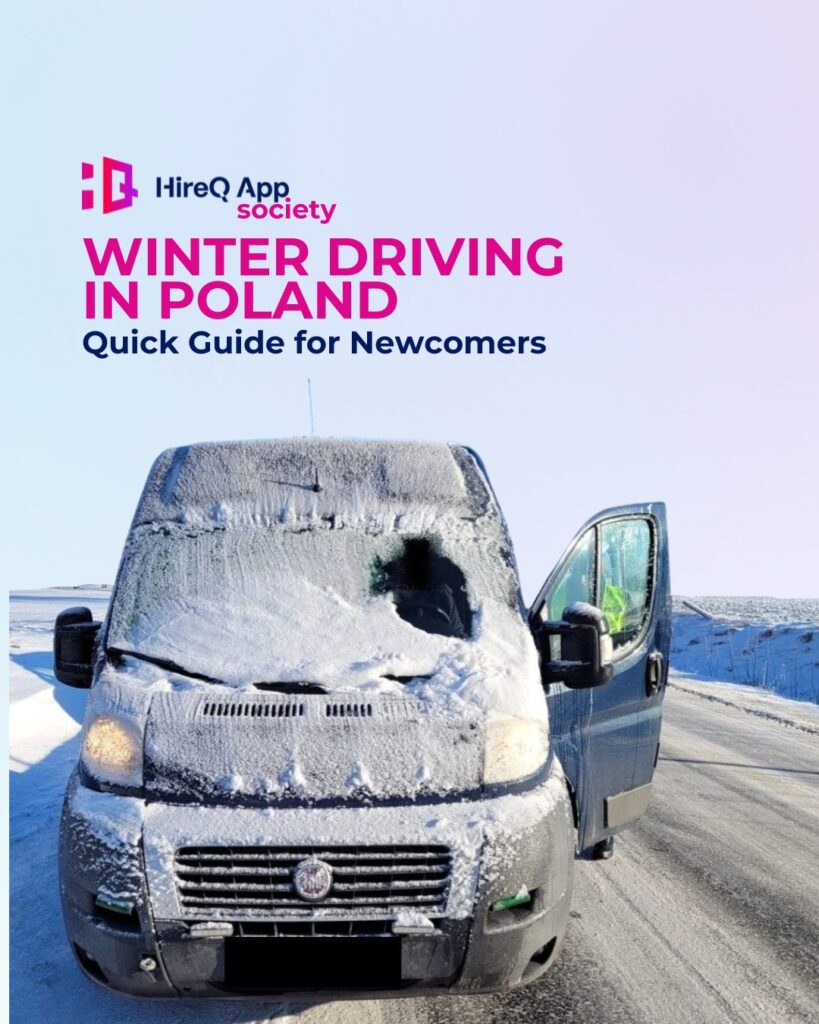
Winter driving in Poland requires preparation and common sense. This quick guide lists a pre-trip checklist (clear snow, check lights/wipers, tyres, emergency kit), common mistakes to avoid (e.g. jazda na czołgistę — driving with only a tiny cleared patch), typical fines, alcohol rules and practical phrases to use if the police stop you. Drive slowly, plan alternatives and never drive after drinking.
Winter in Poland brings snow, ice, slush and poor visibility — and local traffic rules are enforced strictly. Follow these simple steps to stay safe, avoid fines, and understand common Polish phrases you may hear on the road.
🔎 Quick pre-trip checklist (do this before you leave)
- Clear all snow & ice from windows, mirrors, lights, registration plates and the roof.
- Check lights & wipers — make sure headlights, taillights and windscreen wipers work. Carry winter washer fluid.
- Check tyres — tread depth and condition (legal minimum 1.6 mm; winter tyres recommended).
- Pack an emergency kit: ice scraper + brush, small shovel, torch, power bank, warm clothes, water/snack.
- Phone & documents: charged phone, ID/passport, driving licence, vehicle papers.
⚠️ Common dangerous mistakes — don’t do these
- Don’t drive after only scraping a tiny hole in the windscreen — local slang: jazda na czołgistę (also written jazda na czolgistę without diacritics). This means driving with only a small cleared patch and the rest covered with snow — unsafe and can be treated as a hazard.
- Don’t use worn summer tyres on icy roads.
- Don’t ignore faulty wipers or an empty washer bottle — poor visibility is a major risk.
- Don’t drive with obscured lights or unreadable plates — stop and clean them straight away.
💸 Typical penalties (approximate)
- Minor violations (e.g., not fully cleared car): 20–500 PLN (can rise with multiple violations).
- Dirty/covered headlights: ~300 PLN + 8 penalty points.
- Using daytime running lights in heavy rain/snow instead of dipped beam: ~100 PLN + 2 points.
- Unreadable number plates: ~500 PLN + 8 points.
- Serious cases (vehicle deemed dangerous) — fines up to 3000 PLN and up to 15 penalty points.
Note: Exceeding penalty-point limits can lead to loss of driving licence. Criminal offences (e.g., driving over the legal alcohol limit causing harm) carry much heavier penalties.
🚫 Alcohol and driving — simple rule
If you have been drinking — do not drive.
Poland treats drunk driving as a criminal offence in many situations: heavy fines, driving bans, possible imprisonment. For foreigners, criminal records can also affect visas or residence permits. Safer options: taxi (Bolt/Uber), public transport, or a sober friend.
Poland treats drunk driving as a criminal offence in many situations: heavy fines, driving bans, possible imprisonment. For foreigners, criminal records can also affect visas or residence permits. Safer options: taxi (Bolt/Uber), public transport, or a sober friend.
👮 If the police stop you — what to do
- Stay calm and polite.
- Prepare documents: ID/passport, driving licence, vehicle registration.
- If you don’t understand Polish, say: “Nie rozumiem, proszę o tłumaczenie” (I don’t understand, please translate / I need an interpreter).
- If stopped for a visibility issue (dirty plates/lights), clean it immediately if possible.
- If you were drinking — don’t argue; arrange alternative transport.
Useful phrases:
- Nie rozumiem — I don’t understand.
- Proszę o tłumaczenie — Please translate / I need an interpreter.
- Gdzie najbliższa taksówka? — Where is the nearest taxi?
📚 Handy Polish words & slang (with explanation)
- odśnieżyć samochód — clear snow off the car
- płyn do spryskiwaczy zimowy — winter windscreen washer fluid
- opony zimowe — winter tyres
- auto oblodzone — iced car
- światła zapchane błotem — lights covered with dirt
- nieczytelne tablice — unreadable number plates
- jazda na czołgistę / jazda na czolgistę — driving with only a tiny hole cleared in heavy snow (slang; strongly discouraged)
✅ Safer alternatives & final tips
- Plan ahead: avoid driving in heavy snow if possible.
- Use taxi / Bolt / Uber or public transport when weather is bad.
- If you must drive, slow down, increase following distance, and be extra cautious.
- If in doubt — don’t drive.